The Selfish Gene
Richard Dawkins's gene's-eye view of evolution, and the book that introduced the word 'meme'.
Published
26 October 2026
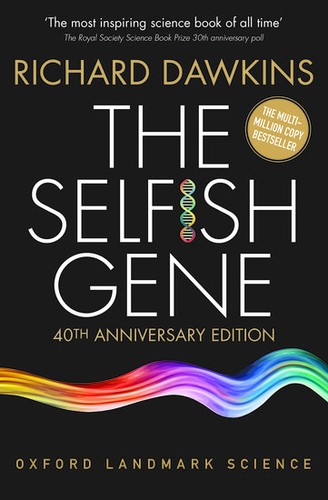
The Selfish Gene asks a question that sounds simple and turns out to be surprisingly hard: when evolution favours whatever survives, what exactly is it that survives? Individuals die. Species change or go extinct. Richard Dawkins, then a young zoologist at Oxford, argued in 1976 that the clearest answer is the gene, the stretch of hereditary material that copies itself from generation to generation, and that bodies are best understood as temporary vehicles, or in his famous phrase, survival machines, built by genes to carry them into the future. The book was not presenting a new discovery. Dawkins was synthesising the work of biologists such as W. D. Hamilton, George Williams, Robert Trivers and John Maynard Smith, whose ideas had transformed evolutionary theory in the previous decade but were little known outside the field. What he added was a vivid point of view, and an extraordinary gift for explaining it.
The book begins at the very beginning of life, with what Dawkins calls replicators. Imagine, in the early oceans, a molecule that happens to be able to make copies of itself from the building blocks around it. Copying is never perfect, so variants arise; some variants are more stable, or copy themselves faster, or more accurately, and these become more common. Over immense stretches of time, some replicators come to build protective structures around themselves, and then more elaborate ones, until the structures are cells, and then organisms. On this picture, our bodies are the latest and most complex in a long line of devices for keeping replicators going. The genes inside us are their descendants.
The word “selfish” has caused more confusion than any other in the book, and Dawkins spends a good deal of effort, then and in later editions, explaining what he meant. Genes do not want anything; they are molecules without minds or motives. To call a gene selfish is a shorthand for a statistical fact: genes that happen to have effects which increase their own chances of being copied will become more common, whatever those effects are, and genes that do not will disappear. It is a description of an outcome, not an intention. Crucially, it does not mean that the animals carrying those genes will be selfish in the ordinary sense. In fact, the most interesting chapters of the book are about how selfish genes, in this technical sense, can produce animals that are cooperative, generous and even self-sacrificing.
The first route to such behaviour is kinship. A gene that leads its carrier to help close relatives, who are likely to carry copies of the same gene, can spread even if the helping is costly to the helper. This idea, developed mathematically by Hamilton, explains a great deal: parents caring for their young, siblings cooperating, and above all the astonishing societies of ants, bees and wasps, in which most individuals never reproduce at all but work for a queen who is their mother or sister. Dawkins explains why the unusual genetics of these insects makes sisters especially closely related, and why that might have made the evolution of such societies easier. The point is not that animals calculate relatedness, but that behaviours which happen to favour relatives will be favoured by selection.
The second route is reciprocity, and here the book turns to game theory. Dawkins describes evolutionarily stable strategies, a concept developed by John Maynard Smith: patterns of behaviour that, once common in a population, cannot be beaten by any alternative. He then explains the prisoner’s dilemma, a simple game in which two players each do better by betraying the other, yet both do worse if both betray than if both cooperate. In the second edition of 1989, Dawkins added a chapter on the computer tournaments run by the political scientist Robert Axelrod, in which programs played the dilemma against each other many times. The winner was one of the simplest strategies entered: cooperate at first, then do whatever the other player did last time. Strategies that were nice, retaliatory, forgiving and clear tended to prosper. The chapter’s title, “Nice guys finish first”, sums up the book’s most hopeful message: cooperation is not an exception to evolution but one of its natural outcomes.
The final chapter of the original edition takes the argument somewhere unexpected. If the essence of evolution is the copying of information with variation and selection, Dawkins asks, are genes the only replicators? He suggests that human culture contains another: ideas, tunes, catchphrases, fashions and techniques that spread from brain to brain by imitation, mutate as they are passed on, and compete for limited attention. He needed a name for this kind of unit, something that sounded like “gene” and evoked imitation, and he coined the word meme. He offered it tentatively, as a way of showing that natural selection is a general principle rather than a fact about DNA. The word went on to have a life of its own, largely unrelated to the theory, which is itself a rather good example of the idea.
The book has been criticised from several directions. Its title is still often taken as a claim that human beings are naturally selfish, which Dawkins explicitly rejects; indeed, he argues that we, alone among animals, may be able to rebel against our genes. Some biologists argue that focusing on genes undervalues other levels at which selection might operate, such as individuals and groups, and that the gene’s-eye view is one useful perspective among several rather than the whole truth. Others have questioned how far the analysis of insects and birds can be carried over to human behaviour. These are live debates, and Dawkins’s later notes, added in subsequent editions, engage with many of them.
What remains, for me, is the power of a change in perspective. Looking at evolution from the gene’s point of view makes many puzzles disappear: why parents care for offspring, why animals warn relatives of danger, why cooperation can be stable. It does not make living things less remarkable. It shows how kindness and cooperation can arise from a process that has no intentions at all, and it does so with a clarity that has made the book a classic. Few works of science make a difficult idea this easy to grasp, and also this hard to misread, if one reads it properly.
Ayoub Khallok keeps this archive of essays, research, lessons and notes, written to understand things more clearly. More about Ayoub.
Enjoyed this piece? Follow along.
New essays, studies, lessons and notes arrive here a few times a month. There's no newsletter or algorithm, just an RSS feed for every section, so you can follow only what interests you.
SubscribeSubjectsScience, Philosophy
Filed inLibrary