The Grand Design
Why is there something rather than nothing? Hawking and Mlodinow's attempt to answer the biggest questions with physics.
Published
25 October 2026
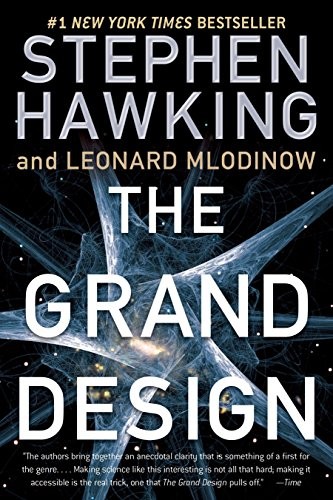
Most science books explain how something works. The Grand Design, published in 2010, goes after the questions people usually leave to philosophy or religion. Why is there something rather than nothing? Why do we exist? Why this particular set of laws, and not some other? Stephen Hawking and the physicist and writer Leonard Mlodinow set out to argue that physics can now say something serious about all three, and they do it in a short, playful, deliberately provocative book, full of cartoons and diagrams, that reads more like a lively seminar than a textbook. It is also one of the books that best captures the kind of curiosity I want this site to be about.
The provocation starts on the first page. Traditionally, the authors write, questions about the nature of reality belonged to philosophy, but philosophy has not kept up with modern developments in science, particularly physics, and scientists have become the bearers of the torch of discovery. In other words, philosophy is dead. It is a deliberately bold line, and many philosophers were quick to point out the irony of a book that goes on to make a series of philosophical arguments about realism, explanation and the meaning of “nothing”. I read it less as a verdict than as a challenge: the biggest questions deserve answers that take the evidence of the last century seriously, and anyone who wants to discuss them should know what that evidence is.
The first philosophical idea the book develops is what the authors call model-dependent realism. To explain it, they tell the story of the Italian city of Monza, which some years ago barred pet owners from keeping goldfish in curved bowls, on the grounds that the distorted view of the outside world was cruel to the fish. Hawking and Mlodinow ask how we know our own view is not distorted. A goldfish physicist, watching objects move through the curved glass, could construct laws of motion that were more complicated than ours but just as consistent and just as good at predicting what it saw. Neither picture would be the true one in an absolute sense. On their account, there is no picture of reality that is independent of the model we use to describe it. What makes a model good is that it is elegant, contains few arbitrary or adjustable elements, agrees with all existing observations, and makes detailed predictions that could prove it wrong. When two models both meet these standards, there is no point in asking which one is real.
This idea runs through the rest of the book, and I find it useful far beyond physics. A model is a tool, not a photograph. Economists, investors, engineers and historians all build simplified pictures of the world, and the question is never whether a model is the final truth but whether it describes what it claims to describe, with as few fudges as possible, and whether it could be shown to be wrong.
The middle chapters turn to quantum physics, and especially to Richard Feynman’s way of thinking about it. In everyday life, a ball thrown across a room follows one path. In Feynman’s formulation of quantum mechanics, a particle travelling from one point to another does not take a single path at all; in a sense, it takes every possible path at once, and the probability of what we observe comes from adding up the contributions of all of them. Hawking and Mlodinow explain the famous double-slit experiment, in which particles fired one at a time at a barrier with two openings build up an interference pattern as if each had passed through both. Then they apply the same idea to the universe as a whole. If quantum theory applies to everything, the universe does not have a single history but a whole collection of possible ones, and the history we observe is shaped, in part, by the fact that we are here to observe it.
The search for a single theory of everything gets a characteristically modest reinterpretation. Rather than one final equation, the authors argue, the best candidate is M-theory, which is not a single theory but a family of overlapping ones, each valid in its own range of circumstances, like the overlapping maps in an atlas, where no one flat map can show the whole Earth without distortion. M-theory allows for a staggering number of possible universes, each with its own laws, its own particles and its own physical constants. Our universe would be one of them.
That leads to the book’s most quoted claim. Because there is a law like gravity, the authors argue, the universe can and will create itself from nothing. Spontaneous creation, they suggest, is the reason there is something rather than nothing, and it is not necessary to invoke an outside cause to set the universe going. The argument depends on the idea that, in quantum physics, the total energy of the universe can be zero, with the positive energy of matter balanced by the negative energy of gravity, so that nothing has to be supplied from outside.
A related chapter takes on the fine-tuning of the laws of nature. Many physical constants appear to be set within narrow ranges that allow stars to burn, carbon to form and life to exist; change them a little and the universe would be empty or sterile. To some, this suggests design. Hawking and Mlodinow suggest instead that if there are many universes with different laws, it is no surprise that we find ourselves in one that allows observers like us, since we could not find ourselves anywhere else. To show how complex structure can emerge from simple rules without a designer, they borrow John Conway’s Game of Life, a grid of cells that live or die according to a few simple rules, and which nonetheless produces patterns that move, collide and reproduce, almost as though they were alive.
This is where the book needs to be read critically. Several of its boldest claims rest on ideas, such as M-theory and the multiverse, that have not been confirmed by experiment and may be very hard to test. Critics have pointed out that the “nothing” from which the universe creates itself is not really nothing, since it already includes the laws of physics and the framework of quantum theory, and the question of why those exist is left untouched. The confident dismissal of philosophy sits awkwardly with a book that is, for long stretches, doing philosophy. None of this makes the book less enjoyable or less valuable. It is at its best as an invitation to think, not as the final word, and its central attitude is one I share: ask the biggest question you can, and then look carefully at what evidence and reason can actually say about it.
Ayoub Khallok keeps this archive of essays, research, lessons and notes, written to understand things more clearly. More about Ayoub.
Enjoyed this piece? Follow along.
New essays, studies, lessons and notes arrive here a few times a month. There's no newsletter or algorithm, just an RSS feed for every section, so you can follow only what interests you.
SubscribeSubjectsScience, Philosophy
Filed inLibrary