Meditations
The private journal of a Roman emperor, and why it still reads like advice from a friend.
Published
5 October 2026
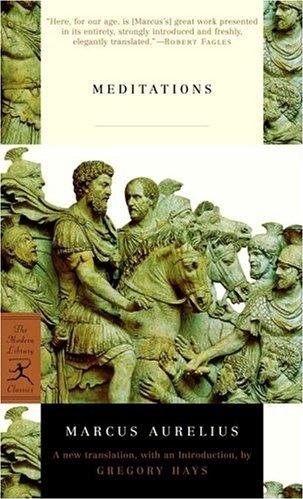
Marcus Aurelius never meant anyone to read this book. He wrote it in Greek, for himself, probably during the last decade of his life, much of it while commanding the Roman armies on the Danube frontier against the Marcomanni and other peoples pressing on the empire’s northern border. The title by which we know it was added later by editors. The heading in the oldest manuscript tradition is closer to To Himself, and that is exactly what it is: a set of private notes in which the most powerful man in the Roman world reminds himself, again and again, how to behave.
That private character is what makes the Meditations unlike any other book of ancient philosophy. It is not a treatise, a dialogue or a speech. It has no argument that builds from beginning to end, and the twelve books into which it is divided are loose collections of entries, some a single line, some a page long, many repeating ideas that have appeared before. Marcus was not trying to persuade anyone or to found a school. He had been trained in Stoic philosophy as a young man, above all through the lectures of Epictetus as recorded by his student Arrian, and in the notebook he is rehearsing what he had learned, trying to keep it alive under the pressure of war, plague, court politics and his own temper.
The idea he returns to most often is the Stoic division between what is up to us and what is not. Our judgments, our intentions and our actions belong to us. Other people, our reputation, our health, the outcome of events, and death itself do not. Most human distress, the Stoics argued, comes from treating the second group as if it were the first: from demanding that the world behave as we want, and suffering when it does not. Marcus applies this to himself relentlessly. When someone insults him, the harm is not in the insult but in his judgment that he has been harmed, and that judgment is his to revise. In one entry he reduces this to a chain of three steps: decline the judgment that you have been harmed, and the feeling of harm goes, and with it the harm itself. It can sound like a trick of words, but in practice it is a discipline of attention: noticing the moment at which an event becomes a grievance, and declining to make that step.
Some of the best-known passages show how practical this discipline was meant to be. The second book opens with a morning exercise. When you wake up, Marcus tells himself, remind yourself that the people you deal with today will be meddling, ungrateful, arrogant, dishonest, jealous and surly. They are like this because they cannot tell good from evil. But none of them can harm you, because none of them can make you act badly, and you cannot be angry with your own kind, who were made to work together like the hands and the feet. Elsewhere, he admits that he finds it hard to get out of bed, and tells himself that he has to go to work as a human being, that he was not born to lie under warm blankets. Readers often find it reassuring that an emperor needed this kind of encouragement. It is one of the reasons the book feels less like a lecture than like a letter from a friend.
The most quoted line in the book comes from the fifth book. An obstacle, Marcus writes, can stop us from acting in one way, but it cannot stop our intentions or our disposition, because the mind adapts and converts the obstacle to its own purposes. The impediment to action advances action. What stands in the way becomes the way. The thought is not that obstacles are secretly good, but that they are material: a setback changes what we can do, and the task becomes doing that well. It is a very Roman kind of resilience, and it has been borrowed by athletes, generals and self-help authors, often without much of the surrounding philosophy.
Alongside this practical advice runs a darker, steadier theme: everything passes. Marcus repeatedly pictures the court of Augustus, with its wife, daughter, descendants and friends, all now dead; or the age of Vespasian, full of people marrying, falling ill, fighting, feasting and scheming, and all of them gone. He reminds himself that Alexander the Great and his mule driver ended up in the same place. The point is not despair. It is proportion. Small irritations, wounded pride and the desire for posthumous fame shrink when seen against the scale of time, and what remains is the present moment, which is the only thing anyone can lose. There is something almost tender in the way Marcus applies this to himself, an emperor reminding himself that his own name will soon be forgotten.
The Meditations is also, unmistakably, the record of a working life. Marcus ruled for nearly twenty years, during which the empire was struck by the Antonine Plague and by long wars on its frontiers. He was not a perfect ruler; historians still argue about some of his decisions, including leaving the empire to his son Commodus, whose reign went badly. The book does not show him as a sage. It shows him frustrated, tired, irritated by flatterers and by his own impatience, and constantly correcting himself. That honesty is part of why the advice is easier to trust. It is the practice of someone who found it hard, written in the margins of a demanding job.
I read the translation by Gregory Hays, published by the Modern Library in 2002, which renders Marcus in plain modern English and has a helpful introduction on his life and the Stoic background. Older translations, such as George Long’s from the nineteenth century, are more formal and widely available in the public domain; reading a few passages in both is a good way to see how much a translator shapes the voice. I would not read the book straight through. It was not written to be read that way, and its repetitions, which feel tiresome at speed, make sense when taken a few entries at a time. It works best as Marcus used it: as a short daily reminder.
What remains after the details is a simple and demanding idea. You cannot control what happens, only how you meet it, so spend your effort there. Marcus did not invent this; it was the common property of Stoic teachers for centuries before him. What he added was the evidence that someone in his position, with every excuse for vanity and anger, could try to live by it, and could be honest in private about how often he fell short.
Ayoub Khallok keeps this archive of essays, research, lessons and notes, written to understand things more clearly. More about Ayoub.
Enjoyed this piece? Follow along.
New essays, studies, lessons and notes arrive here a few times a month. There's no newsletter or algorithm, just an RSS feed for every section, so you can follow only what interests you.
SubscribeSubjectsPhilosophy, History
Filed inLibrary